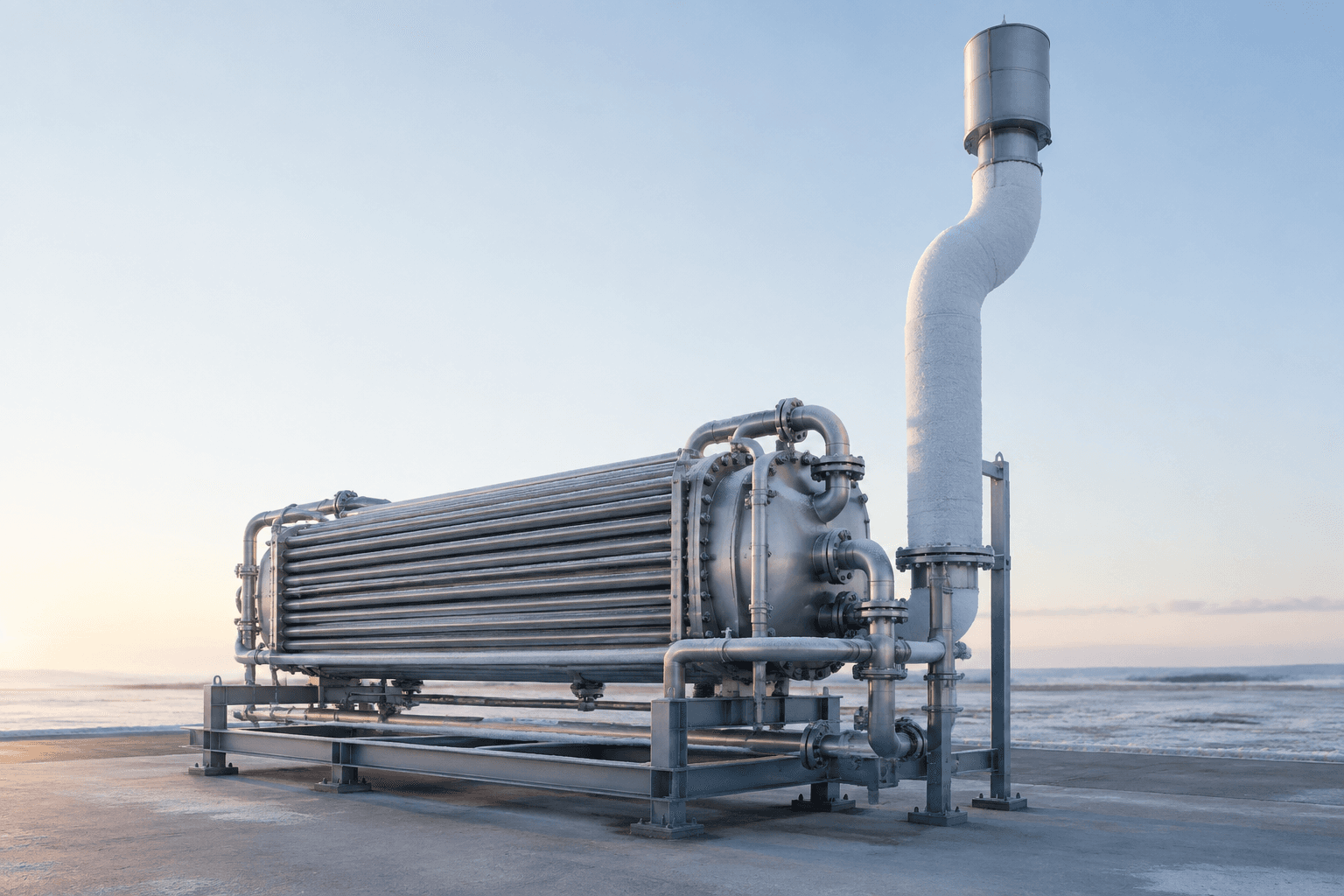
A renewable natural gas plant putting 1,000 MMBtu a day into the pipeline vents roughly 38 tons of CO₂ doing it. Raw biogas runs 35 to 45 percent CO₂ by volume, the upgrader has to strip that out to meet pipeline methane spec, and the separated stream leaves the skid at high concentration. Thirty-eight tons a day is close to two tanker loads.
A single dairy digester putting 100 MMBtu a day into the same pipeline vents just under four tons. Same chemistry, same upgrader, same concentration at the vent. One of those sites can supply a CO₂ market and the other cannot, and no gas analysis will tell you which is which.
The Trailer Is the Unit
A bulk liquid CO₂ trailer carries about 20 tons. Nearly every economic question about a capture project ends up divided by that number, because the trailer is how the product reaches a customer and the trailer does not get smaller for a small source.
At 38 tons a day, a source loads out roughly twice a day. Liquid is made, held a few hours, and gone. At four tons a day it is one load every five days, which means the storage vessel has to hold five days of production and still have room to keep receiving while a truck is on its way. The tank stops being a buffer and starts being the plant.
Liquid CO₂ does not sit for free. It is held near zero degrees Fahrenheit at a little under 300 psi, and staying in that band is refrigeration running against ambient heat for every hour the product is in the vessel. The floor underneath it is hard. Below about 75 psia there is no liquid phase at all, and what comes out is gas and dry ice. Slow turnover buys larger vessels, more refrigeration hours per ton shipped, and a longer window in which something can go wrong before the ton is sold.
Distance Is Part of the Screen
Federal hours of service give a driver 11 hours of driving inside a 14-hour duty window. A round trip that fits in one day and gets the tractor home puts the customer somewhere inside 200 to 250 miles, once loading and unloading take their share of the clock. Past that the delivery costs an overnight, a relay, or a driver waiting on hours.
That is why merchant CO₂ has always been a regional business rather than a national one. The molecule is identical everywhere. The freight is not. A source 400 miles from the closest bottler is competing against one 80 miles away before either has proven anything about the quality of the product.
Put the two together and the screen is simple enough to run on the back of an envelope. Tons per day, and miles to a customer who will actually take them. A stream that clears both is a supply source. A stream that clears neither is a vent stack with good chemistry.
Then the Spec Decides Who Can Buy
Volume decides whether there is a project at all. The spec decides which market it can sell into, and the gap between those two is where most capture projects stall.
Beverage grade means a minimum of 99.9 percent CO₂, benzene held under 20 parts per billion, sulfur compounds below the level a person can taste, and a certificate of analysis tied to the batch riding on that truck. It is the entry requirement for anyone putting the gas into something a person drinks. A distributor serving food and beverage customers cannot take a load that misses it, at any volume and at any distance.
Biogas CO₂ shows up with its own contaminant list. Hydrogen sulfide from the digester. Siloxanes if the feedstock includes landfill or wastewater gas. Volatile organics, oxygen, and nitrogen picked up in the upgrading step. The ones that decide whether a load qualifies are present in parts per billion, which is a different problem than bulk separation and needs different equipment to solve.
That gap is what our cryogenic purification, now patent pending, was built to close. CleanCycleCarbon entered continuous commercial beverage grade production in December 2024, and the thing that made the project work was never the chemistry alone. It was a stream with enough tons per day behind it, close enough to customers who needed the spec.
What This Means If You Run a Source
Run the volume and the radius before you pay anyone to run a gas analysis. A composition report on a stream that produces two tons a day, 300 miles from the nearest buyer, answers a question that does not matter yet. The same report on 30 tons a day inside a duty-day radius is the beginning of a real conversation.
Daily production is the number to start with, not annual tonnage. Annual figures flatten out the seasonality and the downtime, and a source that averages 20 tons a day but delivers it in bursts fills a trailer on a schedule no customer can plan around. Bottlers and distributors buy on a delivery cadence. The vent stack has to match one.
If you buy CO₂ rather than make it, the same arithmetic explains the thing that has frustrated your plant for years. There is no supplier down the road because a supplier down the road needs a waste stream large enough to load out on a predictable cycle, and most of the streams near you are not that. The ones that are tend to be sitting at RNG upgraders, venting a product to atmosphere while somebody trucks the same molecule in from 400 miles away.