Loading…

Loading…
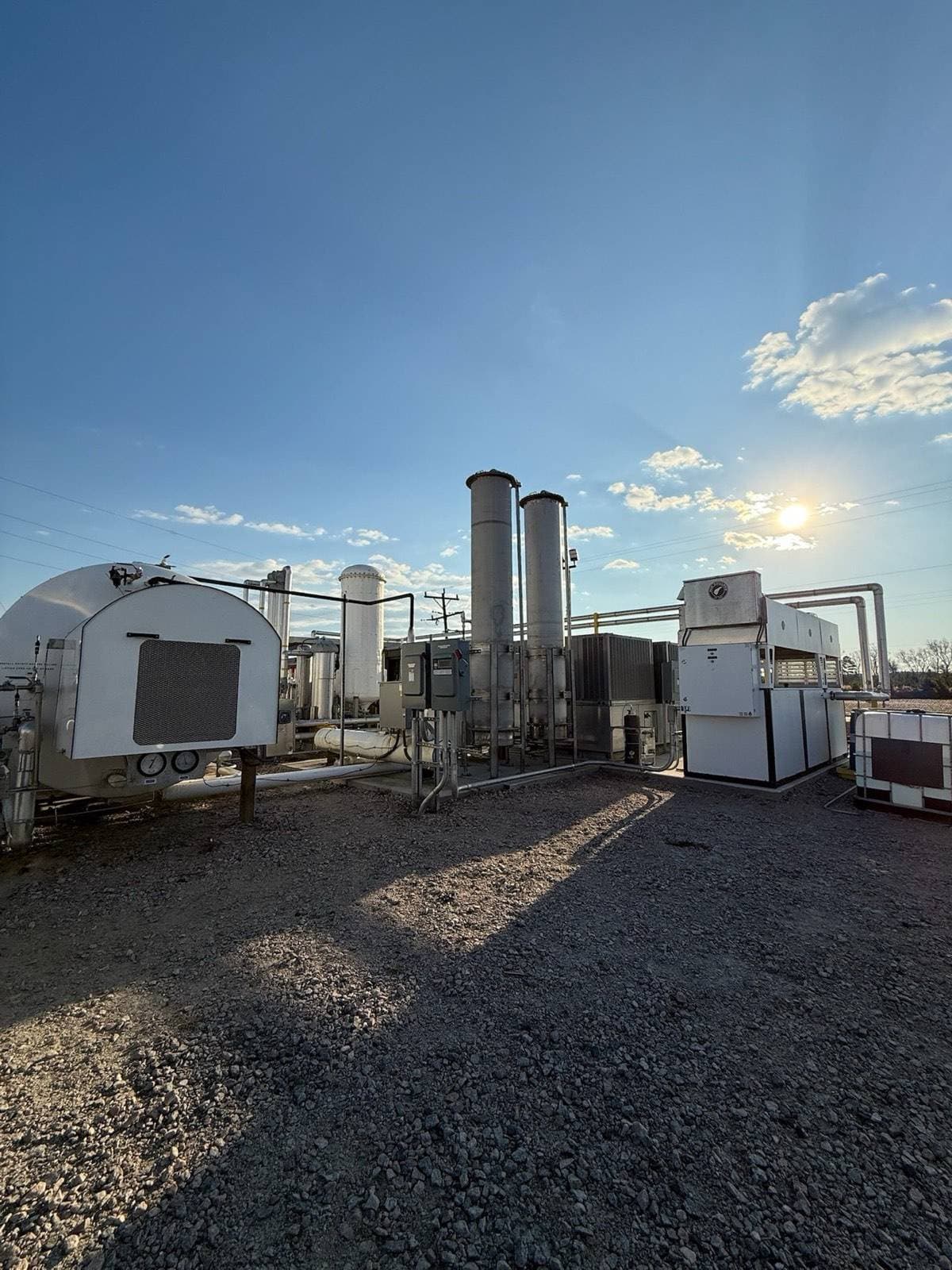
Feedstock: Dairy Biogas
Dairy digesters produce CO₂ that is currently wasted. We capture it and turn it into beverage-grade product.
Companies that produce beverage grade CO₂ from biogas fall into three groups: equipment vendors selling upgrading and recovery hardware, gas majors buying offtake from the biggest projects, and independent capture operators that own and run the purification system at the digester site. CleanCycleCarbon is an independent capture operator, and dairy biogas, roughly 35-45% CO₂ by volume, is one of the feedstocks its cryogenic process is designed for.
The US dairy industry has become one of the fastest-growing sources of renewable natural gas. Large dairy operations use anaerobic digesters to convert manure into biogas, which is then upgraded to pipeline-quality methane. During that upgrading process, the CO₂ in the biogas (roughly 35-45% of the total gas stream) is separated out and vented.
That vented CO₂ represents both a wasted resource and an environmental impact. CleanCycleCarbon captures this CO₂ on-site and purifies it to FDA-registered, beverage-grade quality using a proprietary cryogenic process.
The dairy-to-RNG market is projected to continue growing as state and federal incentives drive investment. Each new dairy RNG project creates a new CO₂ capture opportunity. CleanCycleCarbon is building the infrastructure to capture that CO₂ at scale.
Dairy operations produce manure every day. Unlike seasonal ethanol plants, dairy digesters run continuously, providing a reliable and predictable CO₂ feedstock.
Dairy RNG projects are expanding rapidly driven by LCFS credits, RINs, and voluntary carbon markets. Each new project is a potential CO₂ capture site.
CO₂ from dairy biogas is biogenic, not fossil-derived. This matters for carbon accounting, ESG reporting, and regulatory programs that differentiate by source.
Dairy operations exist across the US: California, Wisconsin, Idaho, Texas, New York, and beyond. This distribution helps build a geographically diverse CO₂ supply network.
Dairy biogas contains contaminants that make CO₂ purification more challenging than other feedstocks: hydrogen sulfide (H₂S), siloxanes, volatile organic compounds, and high moisture content. These must be completely removed to meet beverage-grade specifications.
CleanCycleCarbon's cryogenic purification process handles these contaminants through a multi-stage approach that first conditions the raw gas and then uses low-temperature separation to produce a final product at 99.9% purity or higher. The process is proven: our Lewiston, NC facility has been producing beverage-grade CO₂ at commercial scale from similar industrial emissions.
A typical dairy digester generates a gas stream that is 35-45% CO₂. For large operations, this can represent thousands of tons of CO₂ per year that is currently vented during biogas upgrading.
Yes. CO₂ from dairy biogas originates from biological processes, not fossil fuel combustion. This distinction matters for carbon accounting, emissions reporting, and regulatory programs like California's LCFS.
Yes. Our cryogenic process removes H₂S, siloxanes, moisture, and other contaminants to produce CO₂ at 99.9% purity meeting FDA and ISBT specifications.
No. CleanCycleCarbon handles all capital investment, construction, and operations. The dairy or RNG operator provides access to the gas stream.
Let's explore how CO₂ capture can add a revenue stream to your dairy biogas operation.